In this guide
- Start with the type of name
- Build four layers of context
- Try the layers on a real public connection
- Why employees benefit from this distinction
- Public context has a boundary
- Use the atlas as a conversation aid
- Finish with a usable connection
- Why one public page cannot become the whole map
- Work a cross-site example from beginning to end
- What the homepage explorer is designed to prevent
- Sources and scope
Understand the places, institutions and functions behind the names you encounter at work. An employee system is only one layer of organizational context.
Start with the type of name
A workplace message may mention a hospital, research institute, education partner, service function or employee system. Those names describe different things. Northwell’s public resources identify myExperience functions, the Feinstein research enterprise and community-health work. This atlas connects those public descriptions without pretending to reproduce a private organizational chart or know your reporting line.
Build four layers of context
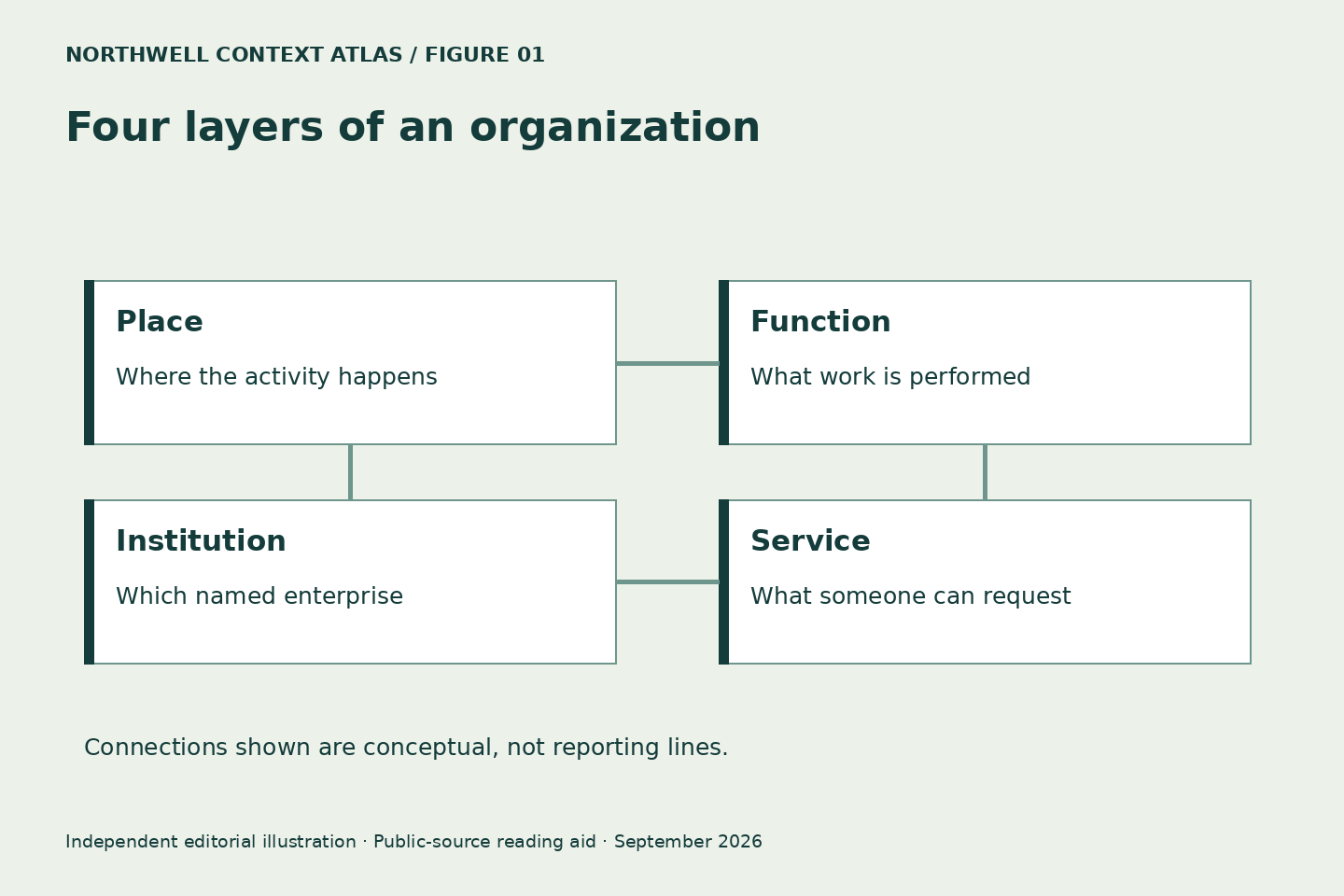
Use place, function, institution and service as separate labels. A place tells you where activity occurs. A function tells you what work is being done. An institution identifies an organization or named enterprise. A service identifies what a person can request or use. One name can touch several layers, so ask which meaning matters in the conversation rather than forcing every name into one category.
Try the layers on a real public connection
The Feinstein Institutes is the named research enterprise in Northwell’s public research overview. A particular research meeting could also have a physical location, a program subject and a host. Those are four different fields on your working map. The public enterprise description answers the institutional question, while the meeting organizer must supply the exact place and current arrangements. Do not draw a reporting line from the enterprise name to the meeting host unless an authorized source actually establishes it. This is how a broad map becomes useful without becoming a fictitious org chart.
Why employees benefit from this distinction
A team coordinating a meeting needs the actual location and host. A colleague discussing a study needs the research program and responsible team. A payroll question needs the applicable employer channel. Routing all three through a familiar hospital name can produce avoidable handoffs. Organizational literacy helps you ask a more precise question even when you are not the person who can decide the answer.
Public context has a boundary
A public page can establish how an organization describes a function or location. It cannot prove current internal reporting relationships, access permissions, staffing or case ownership. The atlas deliberately leaves those questions to verified workplace channels. It also avoids turning a research announcement into clinical advice or an educational partnership into a promise of employee admission.
Use the atlas as a conversation aid
Choose a topic from the homepage explorer: places, research, education, community or shared operations. The result offers a public starting point and a short list of questions to resolve internally. It does not submit a ticket or search an employee directory. No name, employee identifier or case detail is needed to use it.
Finish with a usable connection
A useful result is a sentence such as: “This is a research institution; the meeting is at this verified site; this team owns the next step.” That is more informative than collecting an acronym. Keep the source date with the connection and recheck it when a current action depends on it. Organizations evolve, and a careful map should make that uncertainty visible.
Why one public page cannot become the whole map
Northwell’s locations overview, research page and community-health mission each describe a different slice of the organization. The location page is useful for recognizing named places; the research page identifies a scientific enterprise; the community mission explains a field of work. Combining them into a conceptual atlas is an editorial interpretation, not an official hierarchy. We therefore draw connections only at the level the sources support. A shared name or mission does not establish who reports to whom, who controls a budget or who can approve a particular request.
Work a cross-site example from beginning to end
Imagine a hypothetical employee asked to coordinate an introductory discussion about a research collaboration. Start by identifying the named research program from a current public source. Then ask the authorized organizer who is hosting the discussion and where it will occur. If a hospital name appears in the invitation, preserve its full form and obtain the actual room or virtual link. Finally, identify the decision the discussion is meant to support. The resulting note has an institution, subject, place and owner, each supported by the appropriate source rather than all inferred from one logo.
What the homepage explorer is designed to prevent
The explorer pairs five public-context layers with three purposes: general reading, a work visit and a handoff. Choosing “research” and “visit” should not produce directions to a presumed laboratory. It should remind you that the research source supplies institutional context while the host supplies the actual destination. Choosing “community” and “handoff” should not produce a referral promise. It should identify the need to confirm the current program and authorized route. This purposeful separation is the atlas’s main contribution: it organizes useful context while making the missing operational facts obvious.
Continue with North Shore, South Shore and LIJ: Preserve the Full Place Name, or What the Feinstein Institutes Adds to the Northwell Map.