In this guide
- Identify the research enterprise
- Research and care ask different questions
- Read the level of evidence
- Ask who owns the next step
- The public research overview shows several disciplines
- Keep public and nonpublic information apart
- A useful reading note
- Research disciplines are lenses, not a ranking
- A worked source-reading card
- Choose the next reader carefully
- Sources and scope
Research is a distinct organizational mission. Understand its place without treating a research description as a treatment recommendation.
Identify the research enterprise
Northwell’s public research page identifies the Feinstein Institutes for Medical Research as its research enterprise. For employees, that is a useful connection between everyday operational work and the organization’s scientific activity. The page describes several research disciplines. This guide uses that public institutional context; it does not claim access to study records, unpublished findings or internal research governance.
Research and care ask different questions
A clinical service may focus on an individual’s care, while a research program investigates a defined scientific question. The same organization can participate in both. That relationship does not make every experimental intervention available as routine care. Employees should avoid converting a promising headline into an assurance to a patient, colleague or family member.
Read the level of evidence
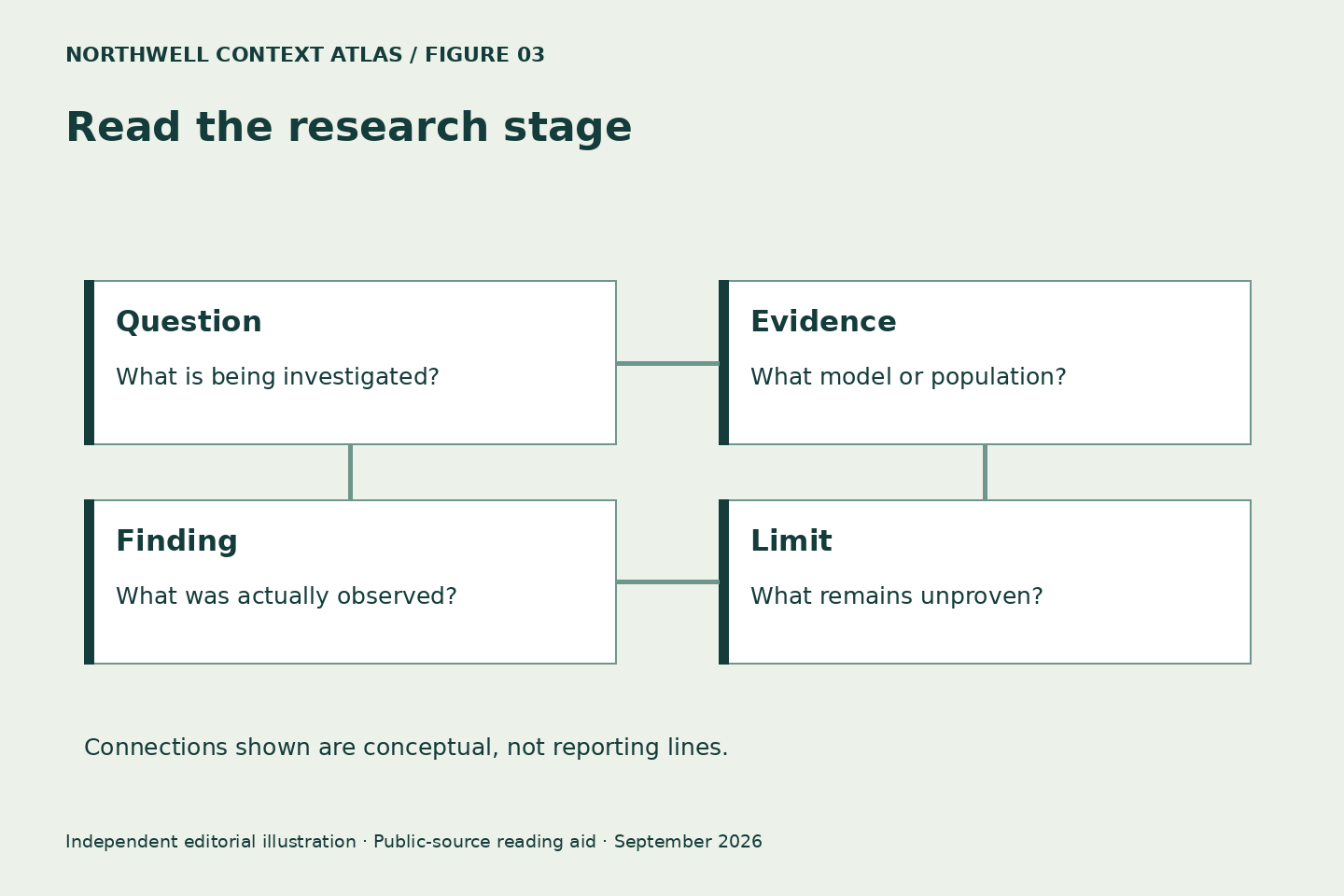
When a public story interests you, look for whether it describes laboratory work, a study involving people, an early result or a broader implementation. These categories are not interchangeable. If the page does not make the stage clear, leave the conclusion limited. The atlas is about understanding institutional roles, not appraising an individual treatment or recommending participation in a study.
Ask who owns the next step
A workplace question about a research collaboration may need the named program or authorized research office. A personal question about care needs the appropriate clinical route. A media inquiry needs the authorized communications channel. The fact that all three relate to research does not mean one contact can answer or approve all of them.
The public research overview shows several disciplines
The official page describes work in behavioral health, bioelectronic medicine, cancer research, health innovation and outcomes research, and molecular medicine. These labels help explain why “research” can mean different questions and methods within the same enterprise. They are not a menu of treatments or a claim that a particular study is open. When you read a story, connect it to the named discipline, study stage and published question. Avoid assuming that a result in one discipline supplies evidence for an unrelated clinical or operational decision.
Keep public and nonpublic information apart
An employee may encounter scientific work in a public article and separately hear internal details. Do not combine the two into an unofficial external summary. Use only information authorized for the intended audience. Avoid discussing identifiable participants or unpublished results in general workplace notes, even when the broader study has a public page.
A useful reading note
Record the research institution, topic, publication date, study stage if stated and the question the source actually answers. Add a separate line for what remains unknown. That note can support a better conversation about the organization’s work without overstating what the evidence shows or implying that your own role grants authority to speak for the research team.
Research disciplines are lenses, not a ranking
The public research overview’s different disciplines indicate that scientific work can ask questions at different scales: biological mechanisms, particular diseases, behavior or the delivery and outcomes of care. That does not create a hierarchy of importance, and it does not mean every article from the enterprise uses the same methods. For employees, the useful reading habit is to identify the question and method in the specific source. Avoid treating a familiar institution name as a substitute for understanding whether a story concerns a laboratory finding, a participant study or an operational analysis.
A worked source-reading card
For a hypothetical public research story, prepare five fields: named team or institution; question being studied; population or model; finding actually reported; and next uncertainty. If the story links to a paper, keep that reference with the card. If it does not explain one field, write “not established in this summary.” The card should never contain a participant’s identity or private clinical information. Its purpose is to preserve the shape of the evidence so that a later conversation does not accidentally transform a preliminary result into a broad claim about treatment effectiveness.
Choose the next reader carefully
A colleague seeking organizational context may need only the public story and the bounded card. Someone asking about clinical relevance needs the appropriate healthcare professional or official study route. A request for an external comment may require communications authorization. These readers can all be interested in the same study but need different information and authority. A useful employee contribution is to make that distinction early, before an informal explanation becomes a promise or an unauthorized statement. The atlas helps identify the kind of question; it cannot supply individualized scientific or medical conclusions.
Continue with Read a Northwell Research Headline Without Skipping the Study Stage, or Community Health Is an Organizational Function Beyond the Building.