In this guide
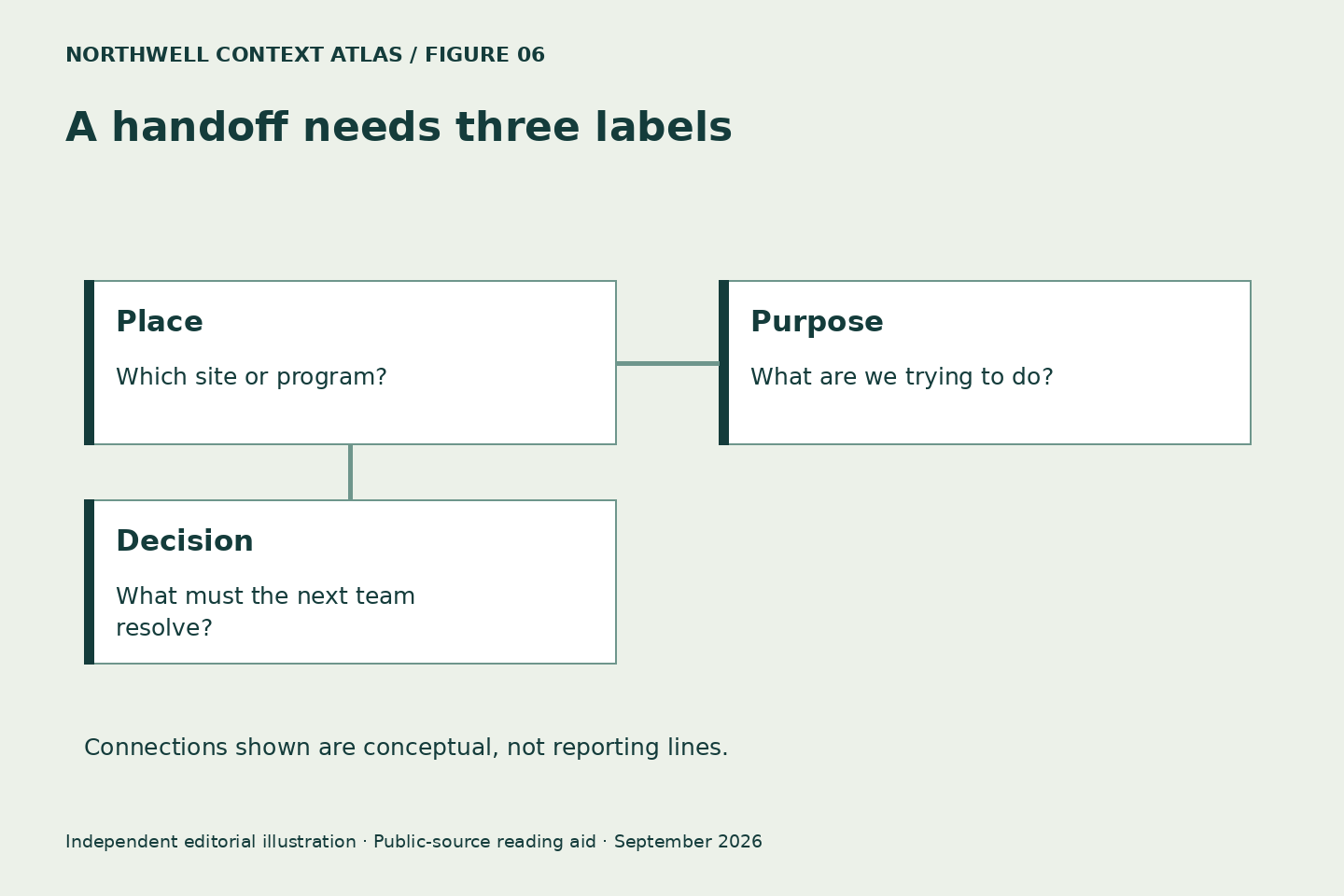
Three clear labels can save several rounds of redirection. Tell the next team where the issue belongs, what it concerns and what decision is needed.
Start with the requested outcome
A handoff should make it possible for the next person to understand why they received it. “Please help with Northwell” is too broad. Identify the work outcome, such as confirming a meeting destination, clarifying the owner of a public program or resolving a technical obstacle. This is an editorial communication method, not an official ticketing procedure.
Add place without overloading it
Include the relevant full facility or program name if location matters. Do not assume the location also identifies the decision owner. A cross-site initiative may involve several facilities and one coordinating function. If the exact place is still uncertain, say so explicitly. An unresolved location is better than a guessed one embedded in a confident message.
State the purpose in ordinary language
Explain what the request is trying to accomplish and what has already been checked. Avoid unexplained acronyms and long copied histories. A short sentence naming the public source or current workplace instruction can provide context without attaching a pile of documents. If sensitive information is involved, move the necessary detail to the approved channel rather than broadening the audience.
Name the decision that remains
Is the next team being asked to identify an owner, approve an action, provide information or confirm completion? These are different requests. Someone may be able to answer a factual question without authority to approve the related action. Making the distinction explicit helps prevent an informative response from being mistaken for permission.
A handoff card with an explicit finish line
| Place | Full host facility confirmed; room still unknown |
|---|---|
| Purpose | Finalize an accurate calendar invitation |
| Decision needed | Host confirms room and arrival instructions |
| Completion evidence | Updated invitation matches the host’s confirmation |
The card does not need participants’ private details. It tells the next person exactly what remains unresolved and how the result will be checked. Once the host responds, update the shared invitation so the earlier incomplete location does not continue to guide attendees.
A compact handoff example
For a hypothetical cross-site workshop, write: “The invitation names this facility, but the room and host are unconfirmed. We need the current arrival instructions before sending the final calendar entry.” That gives the recipient a bounded task. It does not require an unofficial employee directory or disclosure of every participant’s personal details.
Confirm the transfer and the result
If redirected, ask what the receiving team can decide and which reference should accompany the request. Keep the original purpose intact. A forwarded message is a transfer, not necessarily a resolution. Close the loop when the requested information, approval or completion is actually confirmed, and update the shared record so obsolete instructions stop circulating.
Continue with Keep an Organizational Reference Useful After the Names Change, or Read Northwell Geography in Regions, Not a Single Commute.