In this guide
Care, research and education depend on operational connections. Map the handoff rather than assuming one department owns the whole result.
Look beyond the visible endpoint
Northwell’s public reporting includes technology, finance, procurement, communications and other nonclinical work. These functions can support the organization’s clinical, research and community missions. A public story reveals examples of collaboration, not a complete current reporting structure. The employee-facing lesson is to understand how different kinds of work connect before assigning a complex problem to one familiar team.
Map a request through stages
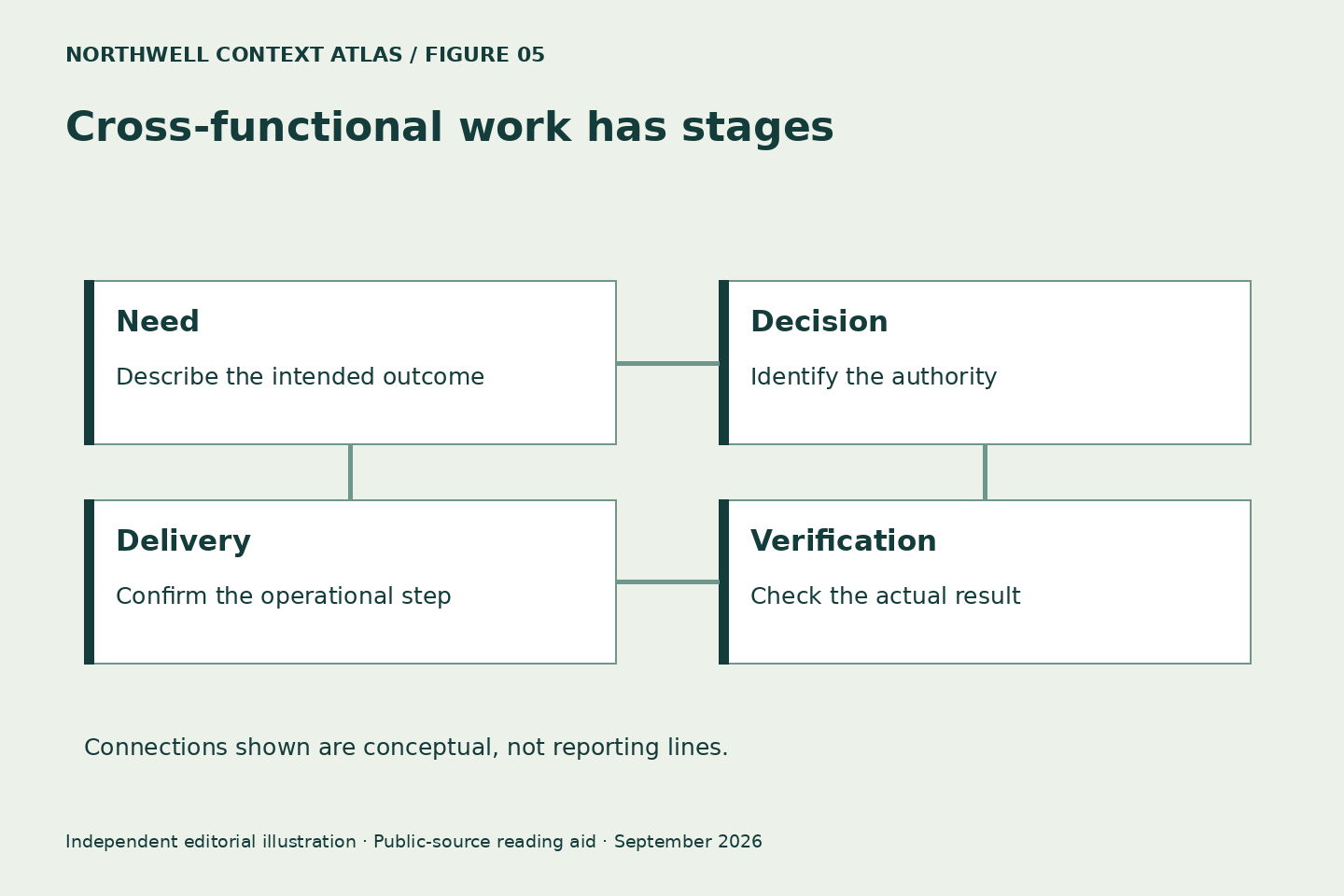
For a hypothetical equipment-related project, separate the need, approval, procurement, delivery, setup and ongoing support. That is a conceptual example, not a Northwell purchasing procedure. Different stages may have different owners and constraints. A request can be approved in one sense while still awaiting another step, so ask which stage is actually complete.
A dependency note that shows the missing input
In a hypothetical room-technology project, equipment may be delivered while setup still awaits an approved configuration and a confirmed access window. “Equipment arrived” is therefore a completed delivery stage, not proof the room is ready. A useful note identifies the missing configuration, the authority who can approve it and the evidence that setup is complete. This keeps the next request small enough to act on. The example does not describe Northwell procurement or IT procedures; the actual organization’s authorized workflow must determine the sequence and owners.
Distinguish dependency from delay
If one team waits for another, identify the missing input rather than assuming inactivity. The input might be a decision, a specification, permission or a confirmed destination. Record it in ordinary language. Avoid escalating a vague complaint about “the system” when a narrow question about the next required input would allow the receiving team to act.
Keep authority visible
Someone who supplies information may not be authorized to approve a purchase, grant access or commit a schedule. Confirm the decision owner through the applicable workplace process. Do not use a public staff profile or an old blog title as evidence of present authority. Roles and reporting lines can change even when the person remains part of the organization.
Write a better project handoff
A useful handoff states the requested outcome, completed stages, remaining dependency and the decision needed. Include only information appropriate for the recipient. Do not attach patient information or private employee records to a general operational request. If sensitive material is necessary, use the approved route and establish why the receiving team needs it.
Measure the completed result
The end of a project is not merely a forwarded email. Define how the requested result will be verified: a delivered item, confirmed access, accepted document or another observable outcome. Keep that confirmation with the project record. This simple habit makes cross-functional work easier to understand without pretending that an unofficial atlas can replace local operating procedures.
Continue with A Technology Team, an Employee System and a Help Request Are Not the Same Thing, or Make a Cross-Team Handoff With Place, Purpose and Decision.